Social Media Monetization and Revenue
Presentation at PANPA (part) and WebDirections 2008 (full). This article is about the various social media monetization strategies and the powerpoint presentation (embedded) shows some case studies and examples, including social network size, the revenue streams, valuations and profits. Click for full size of Revenues for Social Networks diagram. REVENUE SOURCE: The X Axis (the…
Presentation at PANPA (part) and WebDirections 2008 (full).
This article is about the various social media monetization strategies and the powerpoint presentation (embedded) shows some case studies and examples, including social network size, the revenue streams, valuations and profits.
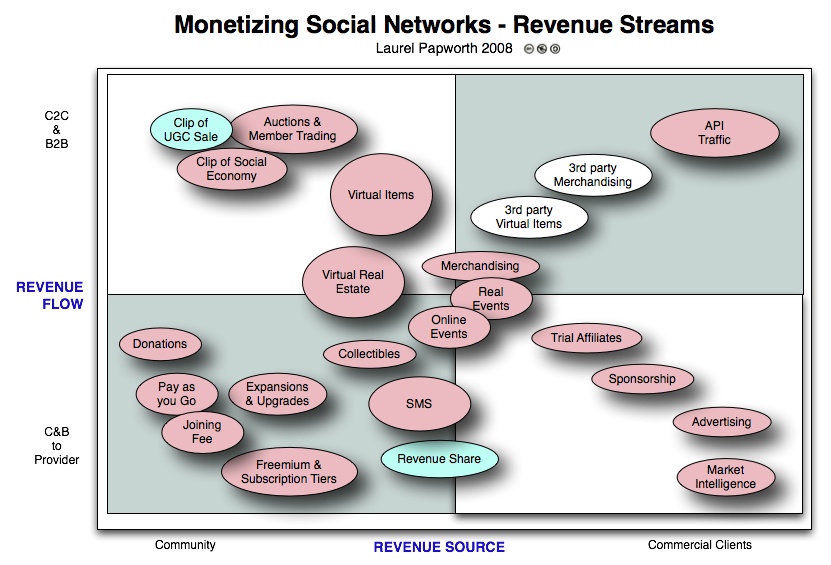
Click for full size of Revenues for Social Networks diagram.
REVENUE SOURCE: The X Axis (the horizontal one) is whether the money comes to you (you are the social network host or provider) from the members in the community or from external clients such as advertisers or sponsorship from companies.
REVENUE FLOW: The Y Axis (vertical one) asks if the money flows in a traditional way i.e. host simply sets a fee to members or external companies. Or whether its a Customer to Customer (C2C) or Business 2 Business (B2B) social network economy. Also known as a peer to peer economy. In these cases, the host gets a “clip of the sale” – a percentage for enabling the transactions to take place. Oh I should mention – B2C works as well. This is where the revenue generated traditionally, say from Advertising, is shared back to the member who uploads the content (creates the page). Like AdSense sharing back to the community.
QUADRANTS: Pretty well break up into
- member pays host.
- external companies pay host.
- host pays members,
- members pay members,
and ones that are hard to show on a chart -heh – such as
- external companies APIs directly empowering members to sell to other members user generated products on demand (e.g. CafePress)
So the list is:
- Donations – wikipedia needs about 4 mill each year. In March they got a donation of 3 million. Open Source has always worked this way. And Shareware. The new widgets that can be added to anything from blog posts to Facebook profiles to wordpress plugins will increase how we show gratitude and value from donated products and services.
- Joining fee (one-off), Pay as you go (each time or per minute), subscription (weekly or monthly) are fairly obvious. High subscription charges or joining fees offer a high barrier to entry and therefore can reflect luxury or exclusivity. Expect to see more. Blizzard have spent $200 million since 2004 (altogether, not yearly) on World of Warcraft and make $1.1 billion per year on their communities.
- Expansions and upgrades work mostly with ‘downloaded software’ based communities such as World of Warcraft ‘Burning Crusade’ expansion and the gazillion that came from Everquest and Ultima online communities. A way of refreshing content and charging for it. In 2D networks its more like to be a premium service (either one off fee or tiered subs).
- Merchandising of real life products through say, CafePress gives either the host or the member, or both, an opportunity to gain revenue from user customisable products on demand. Think of eBay but for new, user created products such as cups and t-shirts. Zazzle is a similar service – here’s the Zazzle Create A Product API.
- API based sales – eBay allowed members to trade on their own sites rather than forcing them to eBay to trade. Revenues increased by 86% for ebay. 40% of Salesforce revenue comes from external sites (API), not their own webite. $490 million per quarter comes from Amazon API, not visiting their site. Not bad. (Thank goodness for Progammable web)
- Along with Merchandising, empowering event management (Upcoming.org, Eventfull) and the taking of ticket purchase can lead to a clip of the ticket sale from the network back to the host.
- Online Events such as poker games that have an entry free or admission fee. These are viral spiked network activities.
- Freemium – sign up for free, get more if you pay tiered subscriptions. LinkedIn makes around $75 million – 100 million (2008). 1/4 of that is advertising, 3/4 tiered subscriptions including corporate services with jobsearch.
- SMS – offering other viral events (Idol SMS voting) or simply text messaging amongst members. Very profitable at the moment, in Australia, for a number of under the radar companies.
- Virtual Goods – 2 billion dollar industry in 2007. Gives Habbo a revenue of $17 per month from 10% of their members adding up to $200million per year . Collectible add a scarcity and (sometimes) a whole sub ecosystem to your virtual or real world products. Think Webkinz or some other fluffy pixel toys. Facebook gifts (only 250, 000 available!).
- Advertising – makes MySpace $2.17 per member per year. TechCrunch about $2.5 million revenue a year. Sucks when it is intrusive. Here’s an online video ad of the future for you
- Trial Affiliates – if you watch an ad, they give you a product for free or discounted, and the advertised company pays them. Also look at $uper Rewards – social network advertising affiliates that place ads in your Facebook games and earn you revenue. Mobwars makes $22k per day for the kids err developers that made it. $uper Rewards said that one (I think Facebook) application made $1million in a week.
- Virtual real estate – this will finally start to move as the Web3D takes off, Google Lively and the new layered social virtual worlds (avatars on standard web pages) are figuring it out but it’s already a nice earner for Linden Labs who make $4 million per month from Second Life real estate sales ($8m each month altogether). Here’s RocketOn showing how to customers use avatars to throw advertising around your webpages
- Revenue share is where the host gives the member a slice of advertising revenue. A la Foneros. User generated content sales can mean the host takes a clip. So too, auction of real world content – anything member to member. Peer to peer economies – host takes a clip of loans, jobs and other (non media) based economic activity between members. Peer to peer banking will be 10.6 billion dollar industry by next year (2009).
- Some networks make money by selling psychographic and demographic information. Market Intelligence may also be customer community discussions around a brand or product/service.
What did I miss?
Presentation has case studies, revenue, figures, and valuations for social network economies. (direct to slideshare powerpoint)
I won’t give you the whole presentation here – the slides are enough, and the podcast will be available – I hope – from WebDirections 08. But here are the key points I hope came through:
- Know your own value. One company charges for video uploads, another (Tube Mogul, YouTube) do it for free, another pays you (Metacafe). Pick a revenue stream, stick to it. If they are giving it away, you charge a fee and raise the entry barrier. Make it a luxury brand. 🙂 We pay for what we value. Caveat: of course that won’t work for the majority of crappy Facebook wannabe networks.
- Follow the network’s values. Currency is a medium of exchange, a store of value, and a standard of value. We monetize where we add one of these values. Even donations simply shows a standard of value (we valued it $x amount).
- Watch for new industries. Virtual Goods was a 2 billion dollar industry in 2007, peer to peer banking will be a $10.6 billion dollar industry by next year. Don’t just focus on how much Linden Labs is making per minute on virtual goods in Second Life, look at the long tail (lots of small companies making small amounts).
- Watch the money – marketers are learning how to engage with networks for the soft returns (brand recall 5x higher in SNs, people return to your website 5x more often, stay 9x as long) but once companies figure out this can be a big revenue earner, everyone will be grabbing their slice of the pie.
- Allow for ecosystems. If you can open APIs, encourage external blogs and forums and wiki databases, and have members trading on eBay your pixel products, premium memberships or some other feature, you have got it made.
And don’t let me catch you saying there are no proven business models for social networks and social media. Heh.
Note: this was based on some presentations since 2005 on virtual world online community business models, adapted for 2D social networks. Where possible the statistcs are sourced directly from the company or their press release in various online press. Where it’s not, it’s hat tipped/linked.
EDIT: I will be adding stuff as we think of it. White Label should’ve been on here, as I’ve spoken on it before (you are the social network host, but you make it look like it belongs to the client). So should’ve franchising (There.com sold the engine to America’s Army). Prepaid cards and merchant sales. Not quite pixel products, but close. Exit strategies (flipping networks is a busy little industry) aren’t really revenue but still, it’s social media money…
Thanks for yet another great post packed with useful content.
Thanks for this article, it is a very interesting overvew of monetisation on SN
Interesting overview article. Another 20 could grow out of this one and of course we see new ideas emerging all the time.
Thanks for sharing. Was this your talk at the recent conference? (very sorry I could not make it)
@simon and @lolo thank you 🙂
@naomi, a few weeks ago I presented it at PANPA (Pacific media proprietors conference) and then on Friday, a version at WebDirections 2008.
is your presentation on Slideshare?
Great Post. Social media has become so powerful I believe because these networks are based on niche interests
awesome resource. i will subscribe for additions to the list.
Great post, Laurel! Gave me a clear overview of the options available. Thanks for sharing!!
Great article. There is some great data here that I look forward to sharing.
.-= Peter Luke Baptiste´s last blog ..Business & Money Thinkology – Do You Understand that Wealth is a Consequence, Not a Reward? =-.
Wow, terrific article loaded with great information.
I think within a couple of year the ‘free’ sector will be bigger than the advertising sector. Also, free programs, like social networks are a real expansion loop, so as a entrepeneur you let the people do the rest…
Great read Laura. Thank you for the post.
Very informative Laura, with social networking websites on the rise it will be very interesting to watch the developments in this sector.
“marketers are learning how to engage with networks for the soft returns ” – Well put. I think this is one of the most overlooked benefits of social networking, it’s great that people are finally catching on.
RT @TweetSmarter: r/t Everything you ever wanted to know about how companies make money from social media: http://bit.ly/hSo8Ku
RT @TweetSmarter: r/t Tons of info here: How companies make money from social media: http://bit.ly/hSo8Ku
How companies make money from social media: http://t.co/u0MuolR via @TweetSmarter
Do you know how social media networks make money?? http://bit.ly/2ahVS3
RT @LisaLeitner: Do you know how social media networks make money?? http://bit.ly/2ahVS3
소셜로 매출을 일으키는 유형을 잘 정리했네요e http://j.mp/foulvw 2008년 내용이지만 현재도 유용!
RT @n0lb00: 소셜로 매출을 일으키는 유형을 잘 정리했네요e http://j.mp/foulvw 2008년 내용이지만 현재도 유용!
RT @n0lb00: 소셜로 매출을 일으키는 유형을 잘 정리했네요e http://j.mp/foulvw 2008년 내용이지만 현재도 유용!
RT @LisaLeitner: Do you know how social media networks make money?? http://bit.ly/2ahVS3
Social Media Monetization and Revenue http://bit.ly/ZL5Q0
RT @mywho88: Social Media Monetization and Revenue http://bit.ly/ZL5Q0
RT @mywho88: Social Media Monetization and Revenue http://bit.ly/ZL5Q0
#gtoz Basics @robbiehills Head Google Rich Media, why ads & social games? "users want to level up & not pay" alt view http://bit.ly/lMxo7t
#gtoz Basics @robbiehills Head Google Rich Media, why ads & social games? "users want to level up & not pay" alt view http://bit.ly/lMxo7t
@TweetSmarter: Tons of info here: How companies make money from social media: http://t.co/dmTaGbH7
RT @TweetSmarter: Tons of info here: How companies make money from social media: http://t.co/oN4aZu3w
Tons of info here: How companies make money from social media: http://t.co/YRSm7fnP
Tons of info here: How companies make money from social media: http://t.co/YRSm7fnP
“@TweetSmarter: Tons of info here: How companies make money from social media: http://t.co/WNi8VPSI”
Tons of info here: How companies make money from social media: http://t.co/YRSm7fnP
RT @TweetSmarter: Tons of info here: How companies make money from social media: http://t.co/GKEvmB7M #in #marketing
Tons of info here: How companies make money from social media: http://t.co/YRSm7fnP
RT @TweetSmarter: Tons of info here: How Companies Make Money From Social Media: http://t.co/i3HFhVuM #socialmedia #SocialBusiness
Tons of info here: How companies make money from social media: http://t.co/YRSm7fnP
☆ Tons of info here: How companies make money from social media http://t.co/V1rLS3OY
r/t Tons of info here: How companies make money from social media: http://t.co/YRSm7fnP
r/t Tons of info here: How companies make money from social media: http://t.co/YRSm7fnP
r/t Tons of info here: How companies make money from social media: http://t.co/YRSm7fnP
r/t Tons of info here: How companies make money from social media: http://t.co/YRSm7fnP
r/t Tons of info here: How companies make money from social media: http://t.co/YRSm7fnP
r/t Tons of info here: How companies make money from social media: http://t.co/YRSm7fnP
r/t Tons of info here: How companies make money from social media: http://t.co/YRSm7fnP
r/t Tons of info here: How companies make money from social media: http://t.co/YRSm7fnP
r/t Tons of info here: How companies make money from social media: http://t.co/YRSm7fnP
How companies make money from social media: http://t.co/pZkY1RIA
How companies make money from social media: http://t.co/pZkY1RIA
How companies make money from social media: http://t.co/pZkY1RIA
RT @TweetSmarter "r/t Tons of info here: How companies make money from social media: http://t.co/8p30iENB"
RT @TweetSmarter "r/t Tons of info here: How companies make money from social media: http://t.co/8p30iENB"
r/t Tons of info here: How companies make money from social media: http://t.co/YRSm7fnP
RT @TweetSmarter: r/t Tons of info here: How companies make money from social media: http://t.co/l6nS1MMj
That was from @SilkCharm! #woot RT @TweetSmarter: r/t Tons of info here: How companies make money from social media: http://t.co/hZNM5qrz
Tons of info here: How companies make money from social media: http://t.co/h7ZQEnrO
RT @TweetSmarter: r/t Tons of info here: How companies make money from social media: http://t.co/l6nS1MMj
r/t Tons of info here: How companies make money from social media: http://t.co/YRSm7fnP
r/t Tons of info here: How companies make money from social media: http://t.co/YRSm7fnP
r/t Tons of info here: How companies make money from social media: http://t.co/YRSm7fnP
RT @TopsyRT: Social Media Monetization and Revenue | @SilkCharm | Laurel Papworth http://t.co/gTtTtZqW
RT @TopsyRT: Social Media Monetization and Revenue | @SilkCharm | Laurel Papworth http://t.co/gTtTtZqW
RT @TopsyRT: Social Media Monetization and Revenue | @SilkCharm | Laurel Papworth http://t.co/gTtTtZqW
r/t Tons of info here: How companies make money from social media: http://t.co/YRSm7fnP
r/t Tons of info here: How companies make money from social media: http://t.co/YRSm7fnP
How companies make money from social media: http://t.co/pZkY1RIA
r/t Tons of info here: How companies make money from social media: http://t.co/YRSm7fnP
opprtnity pass by. soc media is not just for info. http://t.co/vtubwcOb #fb
r/t Tons of info here: How companies make money from social media: http://t.co/YRSm7fnP
☆ Tons of info here: How companies make money from #SocialMedia http://t.co/rfafAgDa
Tons of info: How companies make money from social media: http://t.co/YkMQtKAr Rt @TweetSmarter
RT @GlenGilmore: Tons of info: How companies make money from social media: http://t.co/8p30iENB Rt @TweetSmarter
r/t Tons of info here: How companies make money from social media: http://t.co/YRSm7fnP
RT @tweetsmarter: r/t Tons of info here: How companies make money from social media: http://t.co/xN4Wnpjh
Tons of info here: How companies make money from social media: http://t.co/sF2aT0nt http://t.co/UoMvYbZM
Tons of info here: How companies make money from social media: http://t.co/GAA87Gzr #teamfollowback #1follow1 http://t.co/kme42XRP
r/t Tons of info here: How companies make money from social media: http://t.co/YRSm7fnP
How companies make money from social media: http://t.co/rdZyeyEG
TONS of Info: HOW to Monetize Social Media > http://t.co/YSABuac6 via @GlenGilmore@TweetSmarter #bizforum #sm #pr #li
r/t Tons of info here: How companies make money from social media: http://t.co/YRSm7fnP
☆ Tons of info here: How companies make money from #SocialMedia http://t.co/rfafAgDa
r/t Tons of info here: How companies make money from social media: http://t.co/YRSm7fnP
r/t Tons of info here: How companies make money from social media: http://t.co/YRSm7fnP
Great article and springboard for ideas. Laurel Papworth- Social Media Monetization and Revenue http://t.co/myzXCOvr
r/t Tons of info here: How companies make money from social media: http://t.co/YRSm7fnP
How companies make money from social media: http://t.co/pZkY1RIA
How companies make money from social media: http://t.co/pZkY1RIA
Trending on Twitter: Tons of info here: How companies make money from social media: http://t.co/RyXtO2Hh… http://t.co/zHhHAyfQ #fanzly
Tons of info here: How companies make money from social media: http://t.co/YRSm7fnP
How companies make money from social media: http://t.co/pZkY1RIA
How companies make money from social media: http://t.co/pZkY1RIA
How companies make money from social media: http://t.co/pZkY1RIA
How companies make money from social media: http://t.co/pZkY1RIA
How companies make money from social media: http://t.co/pZkY1RIA
How companies make money from social media: http://t.co/pZkY1RIA
How companies make money from social media: http://t.co/pZkY1RIA
How companies make money from social media: http://t.co/pZkY1RIA
How companies make money from social media: http://t.co/pZkY1RIA
How companies make money from social media: http://t.co/pZkY1RIA
RT @socialguide: How companies make money from social media: http://t.co/OH07D1B6
RT @socialguide: How companies make money from social media: http://t.co/OH07D1B6
RT @socialguide: How companies make money from social media: http://t.co/OH07D1B6
RT @socialguide: How companies make money from social media: http://t.co/OH07D1B6
RT @socialguide: How companies make money from social media: http://t.co/OH07D1B6
RT @socialguide: How companies make money from social media: http://t.co/OH07D1B6
RT @socialguide: How companies make money from social media: http://t.co/OH07D1B6
RT @socialguide: How companies make money from social media: http://t.co/OH07D1B6
RT @socialguide: How companies make money from social media: http://t.co/OH07D1B6
RT @socialguide: How companies make money from social media: http://t.co/OH07D1B6
RT @glengilmore: Tons of info: How companies make money from social media: http://t.co/Zv0tZwNs Rt @TweetSmarter
RT @glengilmore: Tons of info: How companies make money from social media: http://t.co/Zv0tZwNs Rt @TweetSmarter
RT @glengilmore: Tons of info: How companies make money from social media: http://t.co/Zv0tZwNs Rt @TweetSmarter
RT @glengilmore: Tons of info: How companies make money from social media: http://t.co/Zv0tZwNs Rt @TweetSmarter
RT @glengilmore: Tons of info: How companies make money from social media: http://t.co/Zv0tZwNs Rt @TweetSmarter
RT @glengilmore: Tons of info: How companies make money from social media: http://t.co/Zv0tZwNs Rt @TweetSmarter
RT @glengilmore: Tons of info: How companies make money from social media: http://t.co/Zv0tZwNs Rt @TweetSmarter
RT @glengilmore: Tons of info: How companies make money from social media: http://t.co/Zv0tZwNs Rt @TweetSmarter
RT @glengilmore: Tons of info: How companies make money from social media: http://t.co/Zv0tZwNs Rt @TweetSmarter
RT @micronauta: ☆ Tons of info here: How companies make money from social media (@TweetSmarter) http://t.co/FNXopP2i //cc @asalinaf
RT @micronauta: ☆ Tons of info here: How companies make money from social media (@TweetSmarter) http://t.co/FNXopP2i //cc @asalinaf
RT @micronauta: ☆ Tons of info here: How companies make money from social media (@TweetSmarter) http://t.co/FNXopP2i //cc @asalinaf
RT @micronauta: ☆ Tons of info here: How companies make money from social media (@TweetSmarter) http://t.co/FNXopP2i //cc @asalinaf
RT @micronauta: ☆ Tons of info here: How companies make money from social media (@TweetSmarter) http://t.co/FNXopP2i //cc @asalinaf
RT @micronauta: ☆ Tons of info here: How companies make money from social media (@TweetSmarter) http://t.co/FNXopP2i //cc @asalinaf
RT @micronauta: ☆ Tons of info here: How companies make money from social media (@TweetSmarter) http://t.co/FNXopP2i //cc @asalinaf
RT @micronauta: ☆ Tons of info here: How companies make money from social media (@TweetSmarter) http://t.co/FNXopP2i //cc @asalinaf
RT @micronauta: ☆ Tons of info here: How companies make money from social media (@TweetSmarter) http://t.co/FNXopP2i //cc @asalinaf
Tons of info here: How companies make money from social media: http://t.co/8bGtppli via @TweetSmarter
Tons of info here: How companies make money from social media: http://t.co/8bGtppli via @TweetSmarter
Tons of info here: How companies make money from social media: http://t.co/8bGtppli via @TweetSmarter
Tons of info here: How companies make money from social media: http://t.co/8bGtppli via @TweetSmarter
Tons of info here: How companies make money from social media: http://t.co/8bGtppli via @TweetSmarter
Tons of info here: How companies make money from social media: http://t.co/8bGtppli via @TweetSmarter
Tons of info here: How companies make money from social media: http://t.co/8bGtppli via @TweetSmarter
Tons of info here: How companies make money from social media: http://t.co/8bGtppli via @TweetSmarter
Tons of info here: How companies make money from social media: http://t.co/8bGtppli via @TweetSmarter
Tons of info here: How companies make money from social media: http://t.co/8bGtppli via @TweetSmarter
Tons of info here: How companies make money from social media: http://t.co/8bGtppli via @TweetSmarter
Tons of info here: How companies make money from social media: http://t.co/8bGtppli via @TweetSmarter
Tons of info here: How companies make money from social media: http://t.co/8bGtppli via @TweetSmarter
Tons of info here: How companies make money from social media: http://t.co/8bGtppli via @TweetSmarter
Tons of info here: How companies make money from social media: http://t.co/8bGtppli via @TweetSmarter
Tons of info here: How companies make money from social media: http://t.co/8bGtppli via @TweetSmarter
RT @TweetSmarter: Tons of info here: How Companies Make Money From Social Media: http://t.co/i3HFhVuM #socialmedia #SocialBusiness
RT @TweetSmarter: Tons of info here: How Companies Make Money From Social Media: http://t.co/i3HFhVuM #socialmedia #SocialBusiness
RT @TweetSmarter: Tons of info here: How Companies Make Money From Social Media: http://t.co/i3HFhVuM #socialmedia #SocialBusiness
RT @TweetSmarter: Tons of info here: How Companies Make Money From Social Media: http://t.co/i3HFhVuM #socialmedia #SocialBusiness
RT @TweetSmarter: Tons of info here: How Companies Make Money From Social Media: http://t.co/i3HFhVuM #socialmedia #SocialBusiness
RT @TweetSmarter: Tons of info here: How Companies Make Money From Social Media: http://t.co/i3HFhVuM #socialmedia #SocialBusiness
RT @TweetSmarter: Tons of info here: How Companies Make Money From Social Media: http://t.co/i3HFhVuM #socialmedia #SocialBusiness
RT @TweetSmarter: Tons of info here: How Companies Make Money From Social Media: http://t.co/i3HFhVuM #socialmedia #SocialBusiness
it's getting better;) “@GlenGilmore: Tons of info: How companies make money from social media: http://t.co/8lT3PG9Z Rt @TweetSmarter
it's getting better;) “@GlenGilmore: Tons of info: How companies make money from social media: http://t.co/8lT3PG9Z Rt @TweetSmarter
it's getting better;) “@GlenGilmore: Tons of info: How companies make money from social media: http://t.co/8lT3PG9Z Rt @TweetSmarter
it's getting better;) “@GlenGilmore: Tons of info: How companies make money from social media: http://t.co/8lT3PG9Z Rt @TweetSmarter
it's getting better;) “@GlenGilmore: Tons of info: How companies make money from social media: http://t.co/8lT3PG9Z Rt @TweetSmarter
it's getting better;) “@GlenGilmore: Tons of info: How companies make money from social media: http://t.co/8lT3PG9Z Rt @TweetSmarter
it's getting better;) “@GlenGilmore: Tons of info: How companies make money from social media: http://t.co/8lT3PG9Z Rt @TweetSmarter
it's getting better;) “@GlenGilmore: Tons of info: How companies make money from social media: http://t.co/8lT3PG9Z Rt @TweetSmarter
RT @HowellMarketing: #SocialMedia Monetization and Revenue | http://t.co/OeCL3D3U #sm
RT @HowellMarketing: #SocialMedia Monetization and Revenue | http://t.co/OeCL3D3U #sm
RT @HowellMarketing: #SocialMedia Monetization and Revenue | http://t.co/OeCL3D3U #sm
RT @HowellMarketing: #SocialMedia Monetization and Revenue | http://t.co/OeCL3D3U #sm
RT @HowellMarketing: #SocialMedia Monetization and Revenue | http://t.co/OeCL3D3U #sm
RT @HowellMarketing: #SocialMedia Monetization and Revenue | http://t.co/OeCL3D3U #sm
RT @HowellMarketing: #SocialMedia Monetization and Revenue | http://t.co/OeCL3D3U #sm
RT @HowellMarketing: #SocialMedia Monetization and Revenue | http://t.co/OeCL3D3U #sm
RT @TweetSmarter: r/t Tons of info here: How companies make money from social media: http://t.co/C7CVk8MS
RT @TweetSmarter: r/t Tons of info here: How companies make money from social media: http://t.co/C7CVk8MS
RT @TweetSmarter: r/t Tons of info here: How companies make money from social media: http://t.co/C7CVk8MS
RT @TweetSmarter: r/t Tons of info here: How companies make money from social media: http://t.co/C7CVk8MS
RT @TweetSmarter: r/t Tons of info here: How companies make money from social media: http://t.co/C7CVk8MS
RT @TweetSmarter: r/t Tons of info here: How companies make money from social media: http://t.co/C7CVk8MS
RT @TweetSmarter: r/t Tons of info here: How companies make money from social media: http://t.co/C7CVk8MS
#Reminder …How companies make money from social media: http://t.co/YRSm7fnP
#Reminder …How companies make money from social media: http://t.co/YRSm7fnP
RT @TweetSmarter #Reminder …How companies make money from social media: http://t.co/kqN852bc
#Reminder …How companies make money from social media: http://t.co/RRFqb2Vd vía @TweetSmarter
#Reminder …How companies make money from social media: http://t.co/YRSm7fnP
#Reminder …How companies make money from social media: http://t.co/YRSm7fnP
#Reminder …How companies make money from social media: http://t.co/YRSm7fnP
#Reminder …How companies make money from social media: http://t.co/YRSm7fnP
#Reminder …How companies make money from social media: http://t.co/YRSm7fnP
#Reminder …How companies make money from social media: http://t.co/YRSm7fnP
#Reminder …How companies make money from social media: http://t.co/YRSm7fnP
#Reminder …How companies make money from social media: http://t.co/YRSm7fnP
#Reminder …How companies make money from social media: http://t.co/YRSm7fnP
#Reminder …How companies make money from social media: http://t.co/YRSm7fnP
Tons of info here: How companies make money from social media: http://t.co/8bGtppli
Tons of info here: How companies make money from social media: http://t.co/8bGtppli
Información : Tons of info here: How companies make money from social media: http://t.co/i3LUwMW7 RT @tweetsmarter:
★ Las empresas pueden ganar dinero con #socialmedia http://t.co/YXPPcSRo
★ Las empresas pueden ganar dinero con #socialmedia http://t.co/YXPPcSRo
Maneres de fer diners amb els Social Media http://t.co/fmGyLDKM N'hi ha força, però amb totes toca "currar"! 🙁 #diners #socialmedia